
Quick answer: Most leads that don’t convert into sales get lost in one of 4 ways:
- They’re the wrong fit.
- They expected something different.
- Nobody followed up fast enough.
- Nobody tracked what happened to them.
The fix starts with marketing and sales (or the owner doing both jobs) agreeing in writing on what a good lead looks like. After that, every lead needs an owner, a fast reply, and a tracked outcome.
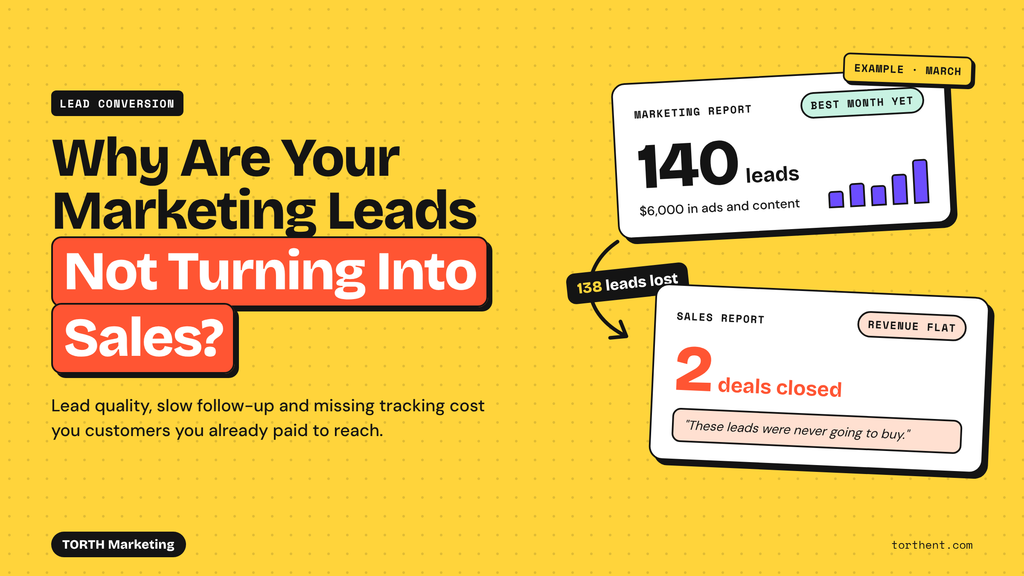
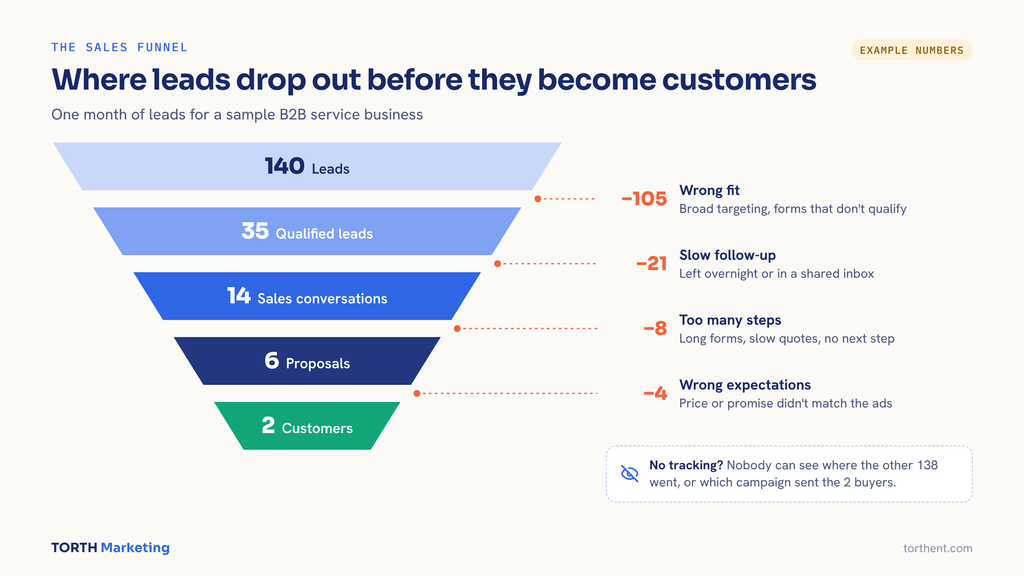
Take a managed IT company that puts $6,000 into their sales funnel and lead generation in March and gets 140 leads, their best month yet. Sales works the list, finds students, one-person shops, and people hunting for free advice, and closes two deals. Marketing blames slow follow-up. Sales blames poor lead quality. Revenue stays flat, and both are partly right.
That standoff is what it looks like when leads don’t convert into sales in a growing company. Owners who handle both jobs see it in their own inbox, full of inquiries that never become paid work. Either way, every one of those leads was paid for with ad spend, content, or hours.
Getting More Leads Doesn’t Always Mean More Sales
Fifty leads that match your ideal customer profile can be worth more than 500 that don’t. That profile is the type of client you serve best, and lead quality is how closely new leads match it.
Cheap leads carry hidden costs. Each one takes time to call, email and sort, so poor lead quality eats the hours sales should spend on real buyers. Good leads wait longer while the team digs through the rest. And a campaign with a low cost per lead can look like a win on a monthly report while bringing in almost no revenue.
A qualified lead is someone who fits the customers you sell to and has a real need you can meet in a reasonable time frame. Judge lead generation by that standard, not by raw form fills.
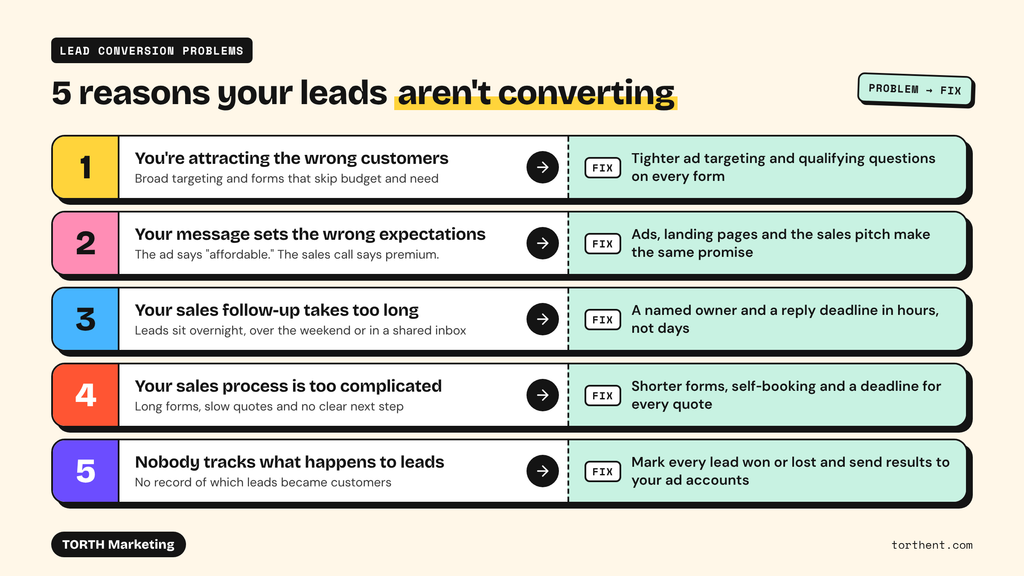
5 Reasons Your Leads Aren’t Converting
If you keep asking, “Why are my leads not converting?” the answer usually sits in one of five places. Most lead conversion problems start well before the first sales call.
You’re Attracting the Wrong Customers
Broad targeting is the usual cause. Ads shown to a whole metro area or to loosely related searches bring in people with little buyer intent. Blog posts built around beginner questions draw students and researchers, not buyers. Free lead magnets often attract people who will never pay, and forms that ask nothing about budget, location or need let them all through.
Fix: If you’re wondering how to improve lead quality, start with tighter paid ad targeting and one or two qualifying questions on every form.
Your Marketing Message Creates the Wrong Expectations
Trust drops when the ad and the sales call tell different stories. An ad promising “affordable” or “setup this week” pulls in buyers shopping on price and speed. Then sales pitches premium service and six-week onboarding, and the lead feels misled. Hidden pricing does the same damage when the first call turns into a price shock.
Fix: Review ads, landing pages and the sales pitch side by side so your marketing copy makes the same promise sales keeps.
Doing both jobs? Read your own ads before your next sales call and make sure you’d say the same thing out loud.
Your Sales Follow-Up Takes Too Long
Lead response time may be the costliest gap of the five. A 2011 Harvard Business Review study, “The Short Life of Online Sales Leads,” audited 2,241 US companies and found the average first response to a web lead took 42 hours. Firms that tried to contact a lead within an hour were nearly seven times as likely to qualify that lead as firms that waited even one hour longer.
Buyers often contact several businesses at once, and the first useful reply sets the tone. A lead left overnight, over a weekend or in a shared mailbox nobody owns rarely waits for you.
Fix: Give every new lead a named owner and a response deadline measured in hours, not days.
Your Sales Process is Too Complicated
Every extra step gives a buyer a reason to stop. Long forms, week-long quotes, three-email booking and calls with no clear next step all stretch the sales cycle. A buyer who has to chase you for a proposal is already wondering what working with you will be like.
Fix: Trim your website forms and booking pages to the fields you use, let buyers book a discovery call themselves, and set a deadline for every quote.
Nobody is Tracking What Happens to the Leads
Leads land in a spreadsheet, an inbox, or a CRM (customer relationship management software), and then the trail goes cold. With no record of who bought, marketing keeps buying the wrong leads, and sales can’t prove what’s wrong with them.
Ad platforms share this blind spot, since they learn from form fills by default. Google says offline conversion imports let advertisers “measure what happens in the offline world after your ad results in a click or call to your business.” That ties ad spend to deals that close weeks later.
Fix: Mark every lead closed-won or closed-lost, and send those results back to your ad accounts.
Marketing and Sales Need to Work Together
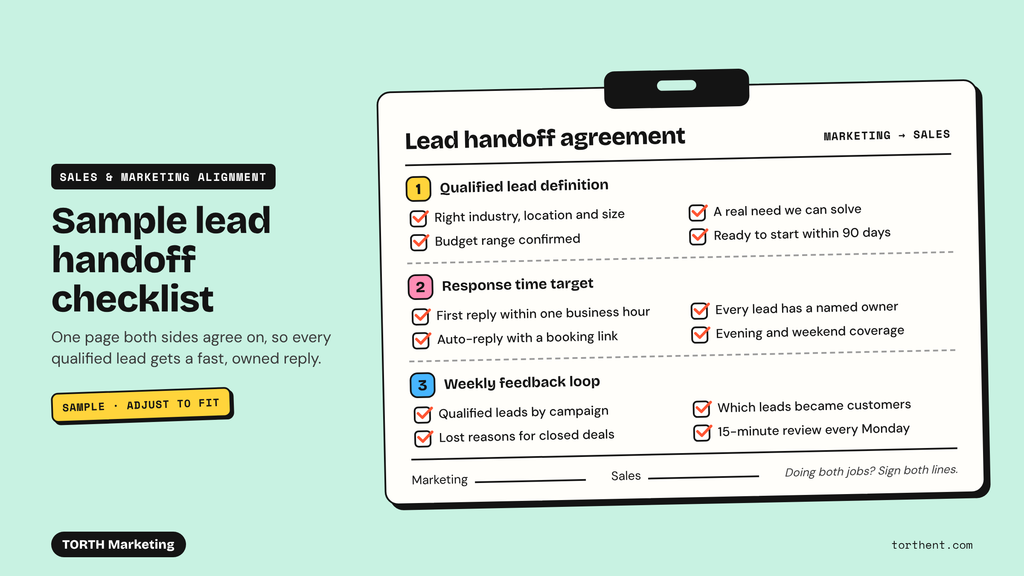
Sales and marketing alignment starts with one shared definition of a qualified lead. Without one, good leads fall through the gap between the two teams.
The simplest tool is a short written agreement, often called a service level agreement (SLA). It sets what makes a lead qualified, how fast sales responds, and what feedback marketing gets each week.
The same agreement settles the MQL vs SQL question. Marketing qualified leads (MQLs) fit the type of customer you sell to. A sales qualified lead (SQL) fits that profile and shows a real need, budget, and timeline, so sales is ready to talk. Some teams use lead scoring, a points system based on traits like company size and actions like pricing page visits, to time the lead handoff.
| Stage | What it means | Example criteria |
| Lead | Someone who raised their hand | Filled out a form, called or booked a call |
| Marketing qualified lead (MQL) | Fits who you sell to | Right industry, location and company size |
| Sales qualified lead (SQL) | Ready for a sales conversation | Has a real need, budget range and timeline |
| Opportunity | In an active sales process | Discovery call done, proposal requested |
| Customer | Paid | Signed and invoiced |
These are example criteria. Lead qualification at a law firm won’t match a software company’s, so adjust them to fit. For Horizon Professional Services, marketing and sales alignment came from replacing scattered efforts with one connected marketing partnership covering the website, SEO, paid ads, email automation and reporting, plus regular strategy sessions. The result was a steady flow of qualified leads.
If You Handle Marketing and Sales Yourself
The two-team problem doesn’t go away in an owner-run business. It moves inside one person’s week, where client work fills the calendar, and new inquiries wait. A few routines keep lead follow-up on track:
- A daily lead window. Answer new inquiries at set times, such as 9 a.m. and 3 p.m.
- A written definition of a good lead. Two or three lines on who they are, what they need, and what they can spend.
- An auto-reply that sets expectations. Confirm you got the message and say when you’ll call back.
- A 15-minute weekly review. Check where each lead ended up: booked, quoted, won, lost or gone quiet.
When delivery work crowds out those routines, hand off the marketing side and keep the sales calls for yourself. That’s where an owner’s time counts most.
How to Improve Your Lead Follow-Up Process
Knowing how to convert leads into sales mostly comes down to what happens after the form fill. Four practices do most of the work.
Respond Quickly
Speed to lead is the time between a lead reaching out and your first real reply. Set a target, such as one business hour, and name an owner for every lead. Instant alerts tell them the moment a form comes in. The auto-reply should confirm receipt and give a real next step, like a booking link. Cover evenings and weekends too, with a rotation, an answering service or a clear note about when you’ll reply.
Use a CRM
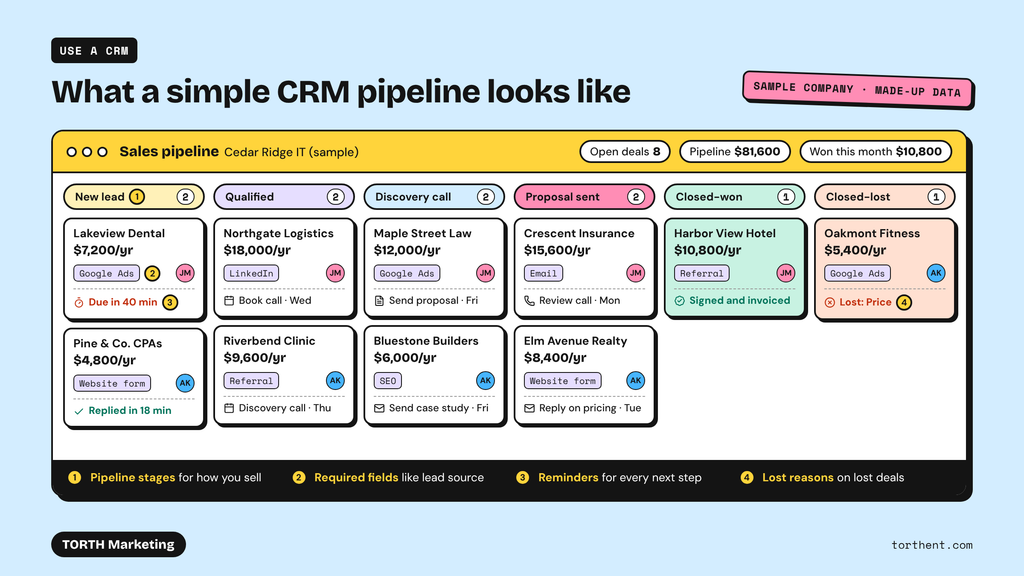
A CRM keeps every lead, conversation and next step in one place, so nothing depends on memory or a crowded inbox. Set up these basics first:
- Pipeline stages that match how you sell, from new lead to closed-won or closed-lost
- Required fields such as lead source, service needed and budget range
- Reminders for every follow-up date
- Lost reasons that must be filled in before a deal is marked lost
Free and entry-level tools cover these basics, so a CRM for small business teams doesn’t need a big budget. Put it on your list of marketing assets every business should own.
Create Useful Follow-Up Emails
Most leads aren’t ready to buy on day one, and “just checking in” gives them no reason to reply. A short follow-up sequence works better when each email has a job: answer a common question, handle a likely objection like price or timing, or share proof such as a client review or case study. Every message should make the next step easy. Well-planned follow-up email sequences keep you in mind until the buyer is ready.
Track Lost Opportunities
Record why each deal is lost, using a short set of reasons: price, timing, chose a competitor, no response or bad fit. Share the totals with marketing every month, because lost reasons are some of the best marketing research a business has. A pile of “bad fit” points to targeting. Frequent “price” losses can mean the ads attract the wrong budget. A run of “no response” leads back to slow follow-up.
What Should Marketing and Sales Measure Together?
Shared numbers end the argument over whose fault it is, so both teams should track the four below. Customer acquisition cost (CAC) is the full marketing and sales cost of winning one customer, and lead conversion rate is the share of leads that become customers.
| Metric | How to calculate it | Why both teams care |
| Lead quality | Qualified leads ÷ total leads | Shows whether marketing is attracting the right people |
| Lead-to-customer conversion rate | New customers ÷ total leads | Shows how well the whole process works |
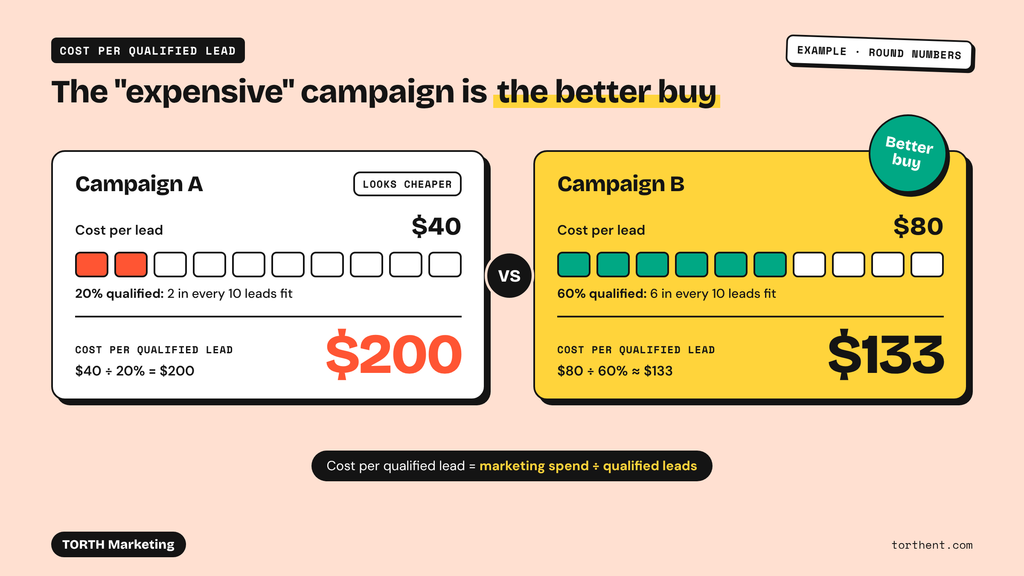
| Cost per qualified lead | Marketing spend ÷ qualified leads | A truer cost than cost per lead |
| Customer acquisition cost (CAC) | Marketing and sales cost ÷ new customers | Shows whether growth is profitable |
For instance, if Campaign A brings in leads at $40 each, but only 20% are qualified, so each qualified lead costs $200. Campaign B costs $80 per lead, but 60% are qualified, so each qualified lead costs about $133. The “expensive” campaign is the better buy.
Summit Financial Group’s campaigns brought in traffic but didn’t turn enough of it into consultations. We rebuilt their landing pages around user intent, added trust content and stronger calls to action, refined targeting, and tracked every important customer action. Lead quality improved, and cost per lead dropped 36%, as the full lead generation case study shows.
When Should You Review Your Sales Funnel?
Review your sales funnel when the numbers and the people stop agreeing. These warning signs mean your lead generation and sales process needs a closer look:
- Lead numbers go up, but sales stay flat.
- Sales and marketing disagree about lead quality every month.
- Leads wait more than a day for a first reply.
- Nobody can say which campaign brought in last month’s customers.
- Close rates are falling, or cost per customer is rising.
- The owner is too busy delivering work to follow up on new inquiries.
If two or more sound familiar, start the review with how your business defines a qualified lead.
Turn More of Your Leads Into Customers
TORTH Marketing works on both halves of the problem. We run lead generation aimed at the right buyers, write landing pages and copy that set honest expectations, set up CRM pipelines and follow-up emails that keep leads moving, and report on cost per qualified lead and cost per customer. We build the growth engine behind ambitious brands, and that engine depends on what happens after the form fill.
Getting leads but not enough sales? Book a lead flow review, and we’ll show you where your leads come from, how fast they hear back, and where they drop out.
FAQs
Respond fast, qualify the lead, and make the next step easy. Reply within an hour if you can, confirm the lead has a real need, budget, and timeline, and book a discovery call. After the call, send a clear proposal quickly and follow up with answers to likely objections. Track every lead in a CRM so none get forgotten.
A marketing qualified lead (MQL) fits the type of customer you sell to, based on traits like industry, location or company size. A sales qualified lead (SQL) has gone a step further: they have a real need, a budget range and a timeline, so they’re ready for a sales conversation. Marketing usually owns MQLs, and sales takes over at SQL.
Within an hour, if possible. A 2011 Harvard Business Review study of 2,241 US companies found that firms that tried to contact a lead within an hour were nearly seven times as likely to qualify that lead as firms that waited even one hour longer. The same study found the average first response took 42 hours.
Chasing lead volume instead of lead quality. Cheap leads make reports look good, but they use up sales time and rarely become customers. A close second is not tracking which leads turned into customers, which leaves marketing guessing about what works. Judge campaigns by cost per qualified lead and cost per customer, not by the number of forms filled.
It varies widely by industry, price point and sales cycle, so another company’s number may not mean much for yours. A firm selling $50,000 contracts usually closes a smaller share of leads than one selling $500 services. Track your own baseline for three to six months, then work on raising it. Your own trend tells you more than an industry average.