
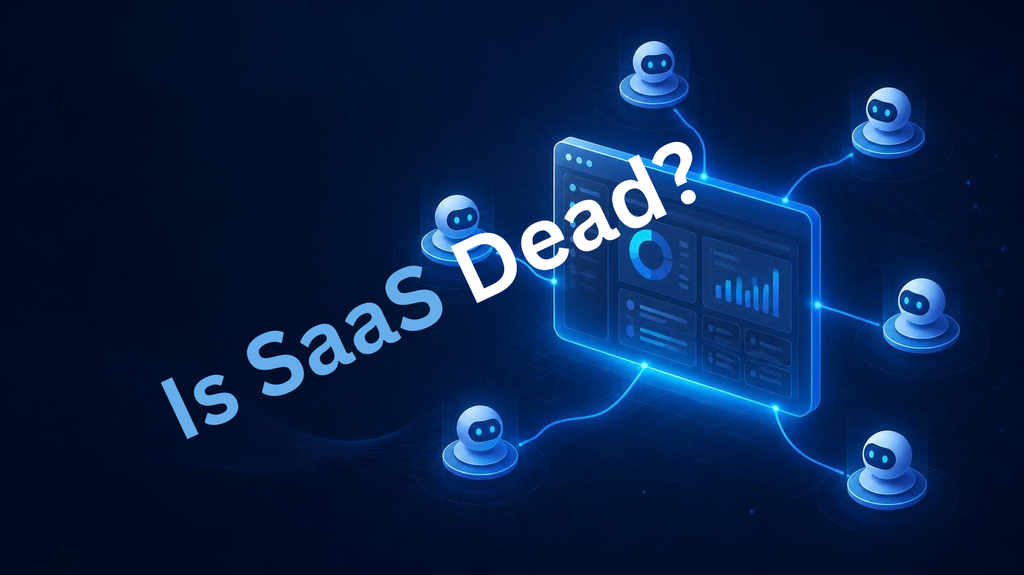
No, SaaS is not dead. AI is killing software that only stores data behind a screen and charges per login. Software that gives AI agents their data, their rules, and a record of what they did is getting harder to replace, not easier.
That’s the short answer. But if you run a SaaS company, market one, or pay for a dozen of them, you’ve probably heard the opposite all year.
In February 2026, software stocks dropped hard after Anthropic showed what their AI agents could do inside everyday business work. Headlines called it the “SaaSpocalypse.” Founders started asking if their product had a future. Investors asked what to sell. Business owners started wondering if they should cancel their tools and just build their own with AI.
But the “SaaS is dead” story skips a big detail. AI agents are good at doing tasks. They are not good at remembering who the customer is, what they’re allowed to touch, which step comes next, or proving later what they did and why. Something has to organize all of that. For most businesses, that something is still software.
In this post, you’ll learn:
- What actually happened during the 2026 SaaSpocalypse
- Which kinds of SaaS are at risk and which are getting stronger
- The five jobs software does for AI (and why agents can’t do them alone)
- How pricing is moving from seats to outcomes
- A simple five-question scorecard to decide whether to build or buy
[Video embed: “Is SaaS dead? The 90-second answer”]
Is SaaS Dead? The Short Answer
SaaS as a business model is alive. What’s dying is a certain kind of SaaS: the simple tool that holds a little data, shows it on a dashboard, and bills you for every person who logs in.
What “SaaS is dead” gets right
- Fewer seats. If an AI agent can handle work that used to take five people, a company needs fewer logins. Per-seat revenue shrinks even if the customer stays.
- Cheap copies. AI coding tools (and the “vibe coding” trend) make it fast to build a basic app. If your product is a form, a database, and a report, someone can now copy it in a weekend.
- Thin AI wrappers. Plenty of new products are a nice screen on top of someone else’s AI model. When the model company adds the same feature, the wrapper has nothing left to sell.
What it gets wrong
Most business software isn’t valuable because of the code. It’s valuable because it holds the official record (the customer file, the invoice, the patient chart), knows the rules for that industry, connects to banks and payroll and regulators, and has years of trust built up with the people who use it.
AI doesn’t replace any of that. It needs all of it. An agent with no clean data, no permissions, and no paper trail is like a new hire on day one with no login, no files, and no manager. Smart, maybe. Useful, not yet.
What Happened in the 2026 SaaSpocalypse
The SaaSpocalypse is the nickname for the software stock selloff that started in early February 2026.
The February selloff in numbers
On February 2, 2026, Anthropic announced new features for Claude Cowork, their AI agent for everyday office work. According to Fortune, investors wiped about $285 billion off the market value of tech stocks within 24 hours.
The drop kept going. On February 6, Forbes reported that:
- The iShares Expanded Tech-Software Sector ETF was down about 21% for the year
- Salesforce stock was down 26%
- Software stocks had lost more than $1 trillion in market value in 2026
- Hedge funds had made about $24 billion betting against software stocks
The wider S&P 500, meanwhile, was roughly flat. This wasn’t a general market crash. It was a bet against one industry.
[Chart: software ETF vs. S&P 500, January to September 2026, with February 2 marked]
Why investors panicked: agents, fewer seats, and vibe coding
The logic was simple. AI agents can now do real office work. If agents do the work, companies need fewer people, which means fewer software seats. And if AI can write code, customers can build their own tools instead of renting yours.
The problem is that the chain has weak links. Fewer seats doesn’t mean less software. It means different pricing. And “customers will build their own” has been predicted for decades. Most don’t, for reasons we’ll cover in the scorecard below.
SaaS has “died” before
If this feels familiar, it should. SaaS has been declared dead again and again. No-code tools, open source, the 2008 financial crisis, and ChatGPT were each supposed to finish it off. In late 2024, Microsoft CEO Satya Nadella said on a podcast that business apps could collapse into AI agents.
History offers a calmer view. Fortune points to desktop publishing. When cheap design software arrived, many expected printing jobs to vanish. Instead, U.S. printing employment climbed through the 1990s and peaked at about 680,000 workers in 1998. Commercial print shops hit an all-time high of about 62,000 in 1995. Some specific jobs, like typesetters, did disappear. The industry itself grew.
Big tech shifts also take longer than headlines suggest. Fortune notes that companies took about four decades to move off COBOL mainframe code, and most of a decade to move from their own servers to the cloud. Businesses don’t rip out the systems that run payroll and billing because a demo looked good.
Even Nvidia CEO Jensen Huang called the idea that AI replaces software “illogical,” according to Forbes. Tools still matter, and AI uses them.
Which SaaS Is at Risk and Which Is Getting Stronger
AI doesn’t hit every product the same way. It sorts them.
At risk: thin AI wrappers, single-purpose tools, and seat-only pricing
These products have the least to fall back on:
- Thin AI wrappers. A chat screen on top of a public AI model, with no data of their own. When the model company ships the same feature, the reason to pay goes away.
- Single-purpose tools. Apps that do one small job, like turning a spreadsheet into a chart or summarizing a meeting. General AI assistants now do many of these jobs for free.
- Simple “CRUD” apps. Software that mostly creates, reads, updates, and deletes records with little business logic on top. These are the easiest to rebuild with AI coding tools.
- Seat-only pricing. Any product whose revenue depends on headcount is exposed when customers need fewer people to do the same work.
Getting stronger: systems of record, vertical SaaS, and compliance-heavy workflows
On the other side are products that AI makes more valuable:
- Systems of record. A system of record is the official source of truth for a business: the CRM that holds every customer, the ERP that holds every order, the HR system that holds every employee file. AI agents have to read from and write to these systems. They don’t replace them.
- Vertical SaaS. Software built for one industry, like dental offices, trucking fleets, or property managers. These products carry years of industry rules, forms, and connections that a general AI model doesn’t know. As CIO put it, AI isn’t killing SaaS. It’s exposing which platforms matter.
- Compliance-heavy workflows. Anything touching money, health records, taxes, or legal filings. A mistake here costs more than a subscription, so buyers want proven, audited software.
Bain’s four scenarios
Consulting firm Bain & Company offers a useful way to think about this. They sort software work by two questions: How much of the user’s task can AI automate? And how easily can outside AI reach into that workflow?
| Scenario | Automation of user tasks | Outside AI reach | What Bain says to do |
|---|---|---|---|
| Core strongholds (AI boosts SaaS) | Low | Low | Add AI to speed up key jobs and protect unique data |
| Open doors (spending compresses) | Low | High | Launch agents fast and limit outside access to data |
| Growth gold mines (AI outshines SaaS) | High | Low | Build end-to-end agents and price by outcome |
| Battlegrounds (AI cannibalizes SaaS) | High | High | Replace your own seats with AI before someone else does |
[Image: Bain’s four-scenario 2×2 grid. Alt text: “Bain’s four scenarios for how agentic AI affects SaaS, sorted by task automation and outside AI reach.”]
The takeaway: SaaS holds up best where outside AI can’t easily reach the workflow. The fight is hardest where it can. Bain’s own tagline sums it up well: disruption is mandatory, obsolescence is optional.
What It Means for Software to “Organize the AI”
Here’s the heart of it. An AI agent is a capable worker. But even the best worker needs a desk, a file cabinet, a rulebook, a schedule, and a manager who checks the work. In a business, software provides all five.
Let’s make it concrete. Picture a customer support agent (the AI kind) that handles refund requests. A customer writes in: “My order arrived broken. I want my money back.” Here’s what has to happen behind the scenes, and which part of the software handles it.
[Image: “The five jobs software does for AI” diagram, with an AI agent in the center and context, permissions, workflow state, guardrails, and audit trail around it]
1. Context: the data the agent works from
Before the agent can act, it needs to know who this customer is, what they ordered, when it shipped, and whether they’ve asked for refunds before. None of that lives inside the AI model. It lives in the system of record: the order system, the CRM, the help desk.
2. Permissions and data governance: who the agent may act for and what it may touch
Can this agent issue a refund at all? Up to what amount? Can it see the customer’s payment details, or only the last four digits? Can it act for every region, or only the U.S.?
These are permission questions, and SaaS products already answer them for human users every day with roles and access controls. The same rules now apply to agents. A business won’t let AI loose in their systems without them.
3. Workflow state and handoffs: AI orchestration across steps
A refund isn’t one step. It’s several: confirm the order, check the policy, approve the amount, send the money, update the order, email the customer, and maybe flag the product for the quality team.
Something has to track where each request stands, what comes next, and when to hand off to a human. That’s AI orchestration, sometimes called AI agent orchestration. Some people call software that does this a “system of action,” because it doesn’t just store records. It moves work forward.
4. Guardrails and checks before an action goes live
AI models make mistakes. They can misread a policy or get a number wrong. Good software catches this before money moves.
Guardrails look like simple business rules: refunds over $500 need a manager’s approval. No refunds on orders older than 90 days. These rules live in the software, not in the model, so they apply the same way every time.
5. The audit trail: a record of what the agent did, when, and why
When a customer disputes a refund six months later, or an auditor asks why an account was changed, someone has to answer. “The AI did it” isn’t an answer.
Software keeps the log: which agent acted, on whose behalf, with what data, under which rule, and what the result was. For regulated industries like finance and healthcare, this record usually isn’t optional. Regulators expect it.
Why this matters for the “SaaS is dead” debate
Look at those five jobs again. The AI model does the thinking. The software does the organizing. Take the software away, and the agent has nothing to read, no limits, no next step, no safety net, and no memory of what it did.
This is also why so many SaaS companies are opening their products to agents through APIs and new standards like the Model Context Protocol (MCP), which lets AI tools connect to software in a common way. They aren’t fighting the agents. They’re becoming the place agents go to get work done.
Data Privacy Is Now a Feature Buyers Pay For
The more AI agents do, the more a business worries about where their customer data goes. That worry is good news for SaaS products that handle data carefully.
First-party data as the moat
For years, marketers leaned on third-party cookies to track people across the web. That era is fading. Safari and Firefox block third-party cookies by default, and privacy laws keep getting stricter. The data that holds value now is first-party data: what customers tell you directly and what they do inside your own products.
Where does that first-party data live? In SaaS products. The CRM, the email platform, the ecommerce store, the help desk. An AI model trained on the public internet knows nothing about your customers. Your software does.
Consent, access controls, and AI governance
Most companies will not paste raw customer records into a general AI chat tool. And they shouldn’t. They need to know:
- Did the customer consent to this use of their data?
- Who can see it, and which agents can access it?
- Where is the data stored, and does it leave the country?
- Can we prove all of the above to an auditor?
This is what people mean by AI governance: the rules and records that keep AI use safe, legal, and accountable. It’s exactly what mature SaaS products have spent years building.
AI Changes the Screen, Not the System Underneath
A lot of the “SaaS is dead” talk is really about the screen. People imagine a future with no menus, no dashboards, no forms. Just a chat box.
From clicks to conversation: chat and voice interfaces
For decades, software has been built around “systems of engagement”: the screens, buttons, and menus people click through to get work done. AI is changing that layer fast.
Instead of clicking through five menus, a manager can type or say, “Show me every invoice over 60 days late,” and get the list. A sales rep driving between meetings can ask their phone to log a call note in the CRM.
But look at where the answer comes from. The overdue invoices live in the accounting system. The call note gets saved to the customer record. The conversation is new. The system underneath is the same one the business already pays for.
Calls, video, and documents as input
AI can now read and listen to things software used to ignore: sales call recordings, support videos, contracts, scanned forms, and screenshots. That’s useful. A support team can have AI watch a customer’s screen recording and spot the bug in seconds.
But someone still has to store that recording, tie it to the right account, and decide who can see it. That’s software work, and there’s more of it every time AI learns to read a new kind of file.
Hyper-personalization runs on the customer record
Every marketer wants to send the right message to the right person at the right time. AI makes that far easier. It can write a different email for every customer, suggest the best offer, or shape onboarding around what a new user actually does.
Here’s the catch: hyper-personalization is only as good as the data behind it. To personalize well, AI needs clean account history, purchase records, product usage, and support tickets. All of that lives in SaaS products. A brilliant AI model with messy or missing customer data will send confident, personal, and completely wrong messages.
The Pricing Shift: From Seats to Outcomes
If any part of SaaS is dying, it’s the per-seat price tag. The software stays. The way you pay for it changes.
Why per-seat pricing breaks when agents do the work
Seat-based pricing made sense when every unit of work needed a person, and every person needed a login. More work meant more people, and more people meant more revenue for the vendor.
AI breaks that link. Let’s run a simple example. (These numbers are illustrative, not from a real vendor.)
- A support team has 50 agents, each paying $100 per month for a help desk tool. The vendor earns $5,000 a month.
- The company adds AI agents that handle about 60% of incoming tickets. They now need only 20 human agents.
- Under per-seat pricing, the vendor now earns $2,000 a month. That’s a 60% revenue drop, even though the software is doing more work than ever.
Now change the model. Say the vendor keeps charging $100 per human seat, but adds $1 for every ticket the AI resolves. If the team gets 5,000 tickets a month and AI resolves 3,000 of them:
- 20 human seats = $2,000
- 3,000 AI resolutions = $3,000
- Total: $5,000 a month
The vendor’s revenue holds steady. The customer pays for results instead of logins.
That’s why Bain advises SaaS companies to move from seat-based pricing toward outcome-based pricing, such as tasks completed or tickets resolved. Forbes points out that the SaaS companies likely to come out ahead are the ones that deliver measurable gains that clearly outweigh what the customer pays.
Seat vs. usage vs. outcome-based pricing
| Model | How you pay | Who carries the risk | Best fit |
|---|---|---|---|
| Per seat | A fixed fee per user, per month | The buyer (you pay whether you use it or not) | Tools where people do most of the work |
| Usage-based | Per action, message, or unit of data | Shared | APIs, data tools, AI features with variable demand |
| Outcome-based | Per result, like a resolved ticket or booked meeting | The vendor (no result, no fee) | Workflows where AI finishes the job end to end |
| Hybrid | A base platform fee plus usage or outcome fees | Shared | Most SaaS products during the shift |
For most companies, hybrid pricing is the practical middle ground. If you’re a buyer, expect to see more of these models in your renewal quotes, and ask how “an outcome” is defined before you sign.
Build or Buy? A Scorecard for Business Owners
So should you cancel a tool and build your own version with AI? Sometimes, yes. Most of the time, no. Here’s a quick way to decide.
This isn’t a new question. Economist Ronald Coase started studying the “make or buy” decision back in the 1930s. His basic idea still holds: a company should build in-house only when that’s cheaper than buying from the market, once you count all the hidden costs. AI has made the first version of a tool cheaper to build. It hasn’t made running, securing, and fixing that tool for the next five years any cheaper.
The five-question scorecard
Answer yes or no for the tool you’re thinking about replacing:
- Does it hold data you’re legally required to keep or protect? (Customer records, payroll, health data, financial transactions.)
- Do more than two teams depend on it every week?
- Would a mistake cost you real money or customer trust?
- Does it connect to outside systems like your bank, payroll provider, tax software, or a government agency?
- Do you lack someone in-house who can maintain a custom tool for years, not weeks?
[Graphic: Build-or-Buy Scorecard, with a download button for the one-page PDF]
How to read your score
- 0 to 1 “yes” answers: Consider building. This is likely a simple, low-risk tool. An AI-built replacement could save you money. Good candidates include internal checklists, simple calculators, one-team reports, and basic intake forms.
- 2 “yes” answers: Look closer. Price out the full cost of building, including your team’s time to maintain it.
- 3 or more “yes” answers: Buy. The risk and upkeep outweigh the savings. Keep the software, and look for vendors that add AI agents on top of the system you already trust.
What SaaS Companies Should Do Next
If you run or market a SaaS product, the goal is simple: become the software that organizes the AI, not the software AI goes around. Here’s a practical checklist.
- Open your product to agents. Offer clean APIs and support standards like MCP so customers’ AI tools can work inside your product instead of scraping around it.
- Build the five jobs into your product. Make sure agents get the right context, clear permissions, tracked workflows, business-rule guardrails, and a full audit trail.
- Add AI where it saves your users real time. A Federal Reserve Bank of St. Louis finding cited by Fortune put the average time saved by generative AI users at about 2.2 hours a week. Find where your product can beat that.
- Test outcome-based or hybrid pricing. Pick one feature or one customer segment and try pricing by results. Learn before you’re forced to change.
- Rewrite your positioning around results. If your website still sells “seats” and “features,” update it to sell outcomes: tickets closed, hours saved, errors avoided, revenue recovered.
Frequently Asked Questions
Is SaaS dead?
No. AI is hurting SaaS products that only store data behind a screen or charge per seat for work agents can now do. Software that holds the system of record, sets permissions, and keeps an audit trail is becoming more important, because AI agents need that structure to act safely.
Is AI killing SaaS?
AI is killing some SaaS, not all of it. Thin AI wrappers, simple single-purpose apps, and seat-only pricing are under real pressure. Vertical SaaS, systems of record, and compliance-heavy software are getting stronger as AI grows.
What was the SaaSpocalypse?
It’s the nickname for the software stock selloff that began in early February 2026. Fortune reports that about $285 billion in tech market value disappeared within 24 hours of Anthropic announcing new Claude Cowork features on February 2.
What will replace SaaS?
Most likely, SaaS with AI agents built in. The screen becomes a chat or voice box, pricing shifts toward usage and outcomes, and the software’s main job becomes feeding AI clean data and rules. Thin, single-purpose tools are the ones most likely to disappear.
Is micro SaaS dead?
Not all of it. Micro SaaS that wraps a general AI model with little else is easy to copy and at high risk. Micro SaaS that owns a niche workflow, niche data, or a compliance need still has room to grow.
The Bottom Line
SaaS isn’t dead. It’s being sorted.
Here’s what to take with you:
- The 2026 SaaSpocalypse was real, but it was a bet on the future, not proof that software stopped working.
- Thin wrappers, single-purpose apps, and seat-only pricing are at risk. Systems of record, vertical SaaS, and compliance-heavy tools are getting stronger.
- AI agents need software to organize them. Context, permissions, workflow state, guardrails, and an audit trail don’t come from the AI model. They come from the software.
- Pricing is moving from seats to outcomes. Hybrid models will be the norm for a while.
- Most businesses should keep buying the software that runs their core work, and build only the small, low-risk tools.
AI does not kill SaaS when the software organizes the AI. That’s the future of SaaS: software that makes AI useful, and becomes worth more because of it. The companies that win will be the ones that say so clearly.
Is your SaaS website still selling seats?
If your homepage and pricing page still talk about logins and features, buyers in 2026 may read that as a product AI can replace. TORTH Marketing helps SaaS companies rewrite their positioning around the results they deliver.
[Book a free 20-minute review of your website copy and pricing page →]
Not ready for a call? [Download the one-page Build-or-Buy Scorecard] and use it at your next software renewal.
SEO details (not for publishing)
| Field | Value |
|---|---|
| Meta description (153 chars) | Is SaaS dead? Not the software that runs AI agents. See which SaaS survived the SaaSpocalypse, why systems of record matter, and how pricing is changing. |
| Title tag (50 chars) | Is SaaS Dead? Why AI Needs Software to Organize It |
| URL slug | /is-saas-dead-ai/ |
| Primary keyword | is SaaS dead (H1, first sentence, H2, FAQ) |
| Secondary keywords used | SaaSpocalypse, SaaS is dead, is AI killing SaaS, systems of record, vertical SaaS, AI orchestration, AI agent orchestration, system of action, systems of engagement, outcome-based pricing, per-seat and seat-based pricing, AI governance, first-party data, Model Context Protocol, future of SaaS |
| Word count | About 3,800 words (body, not counting placeholders) |
| Schema | BlogPosting + FAQPage (the five FAQ questions above) |
Before publishing:
- Swap the bracketed placeholders for the video, chart, Bain 2×2, five-jobs diagram, and scorecard graphic.
- Link the two CTA buttons to the review-call booking page and the scorecard download.
- Recheck the Fortune and Forbes figures against the linked pages on publish day.
- The pricing example is labeled illustrative. Keep that label unless you swap in a real vendor’s public pricing.