
Quick answer: When you have ads getting clicks but no conversions, the problem usually sits in one of three places. The ad is reaching people who were never going to buy, the offer or landing page gives them no reason to act, or broken tracking and slow follow-up hide what happened after the click. Fix those in that order before you raise the budget. Clicks don’t pay the bills, customers do.
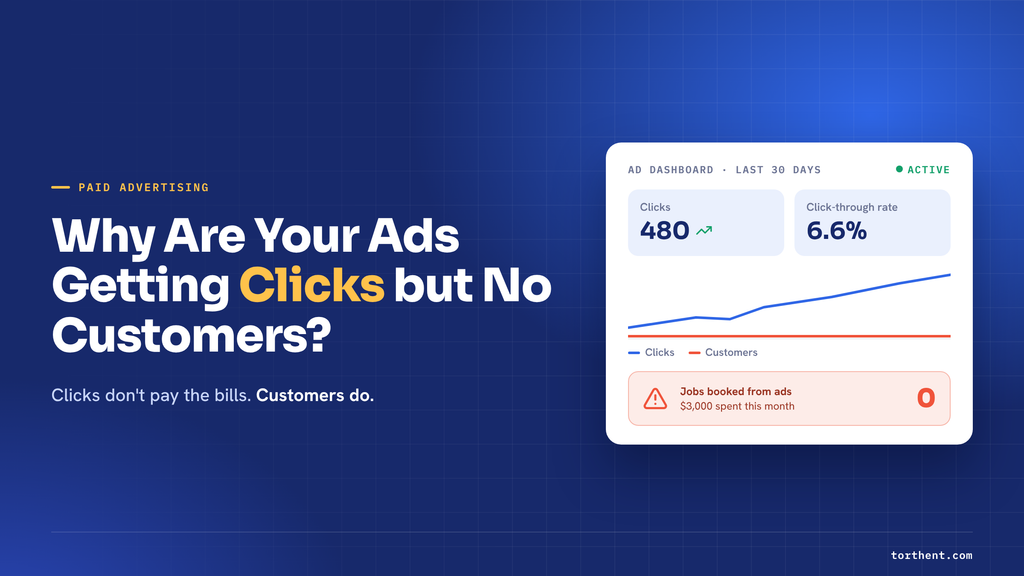
Take a family-owned HVAC company in Raleigh that spends $3,000 a month on ads. The Google Ads dashboard shows 480 clicks and a healthy click-through rate. Their Facebook and Instagram ads pull in plenty of likes too. The phone rang nine times all month, and not one caller booked a job. That’s Google Ads clicks but no conversions, with Facebook Ads not converting either.
Good paid advertising management looks past the click to the sale. Plenty of owners pay hundreds or thousands of dollars a month for ads that look busy and bring in nothing. Below, you’ll see where customers drop off and what to fix before you spend more.
Getting Clicks Doesn’t Mean Your Ads Are Working
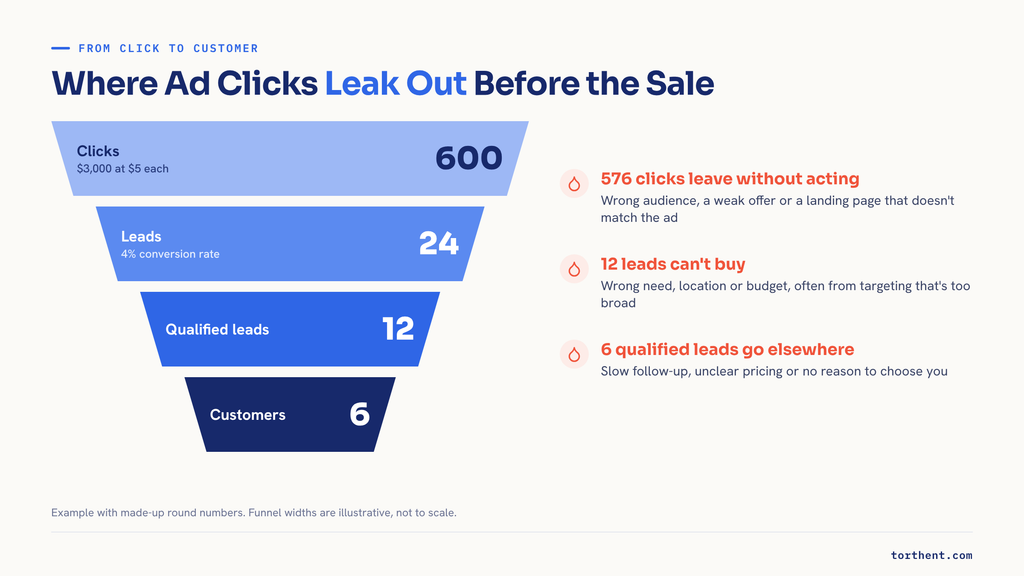
A click tells you someone was curious enough to tap. It doesn’t tell you they called, bought, or even read past the headline. Google defines a conversion action as “a specific customer activity that is valuable to your business” (Google Ads Help, “About conversion measurement”).
Each step from ad to revenue means something different:
- Click: someone tapped the ad. It costs you money and proves nothing yet.
- Lead: someone took an action you can follow up on, such as a call, form, booking, or chat.
- Qualified lead: a lead who can actually buy, with the right need, location, and budget.
- Customer: a qualified lead who paid.
- Sale value: what that customer is worth to the business over time, also called customer lifetime value.
Click-through rate (CTR) is the share of people who saw your ad and clicked it. Conversion rate is the share of those clicks that became a lead or sale. A campaign can post a strong CTR and a cheap cost per click (CPC) and still lose money, because a low advertising conversion rate means you’re paying for visitors who leave.
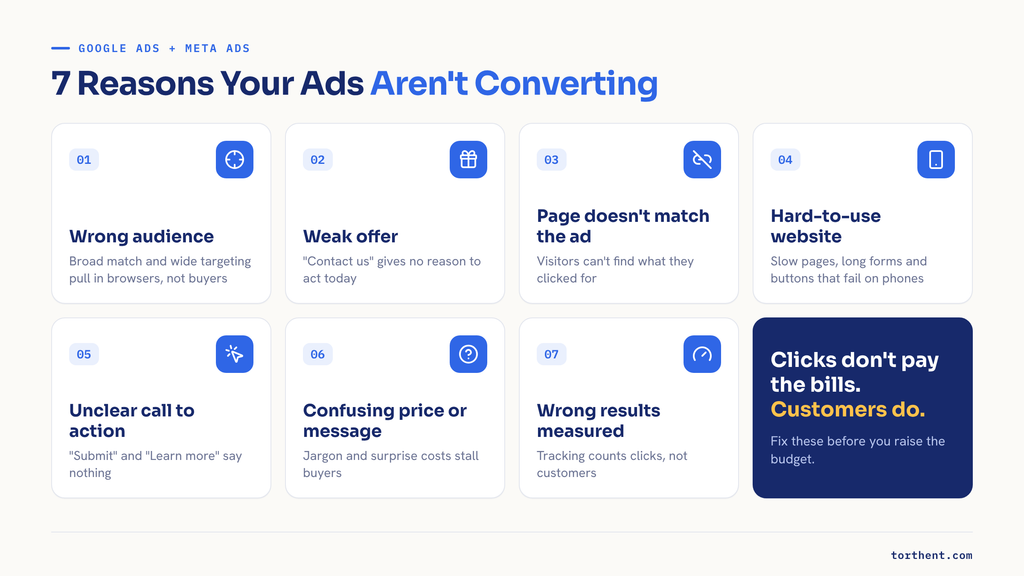
7 Reasons Your Ads Aren’t Converting
Ask ten owners “why are my Google Ads not converting?” or “why are my Facebook Ads not converting?” and the answers land in the same seven places. Most apply to both Google and Meta.
You’re Targeting the Wrong Audience
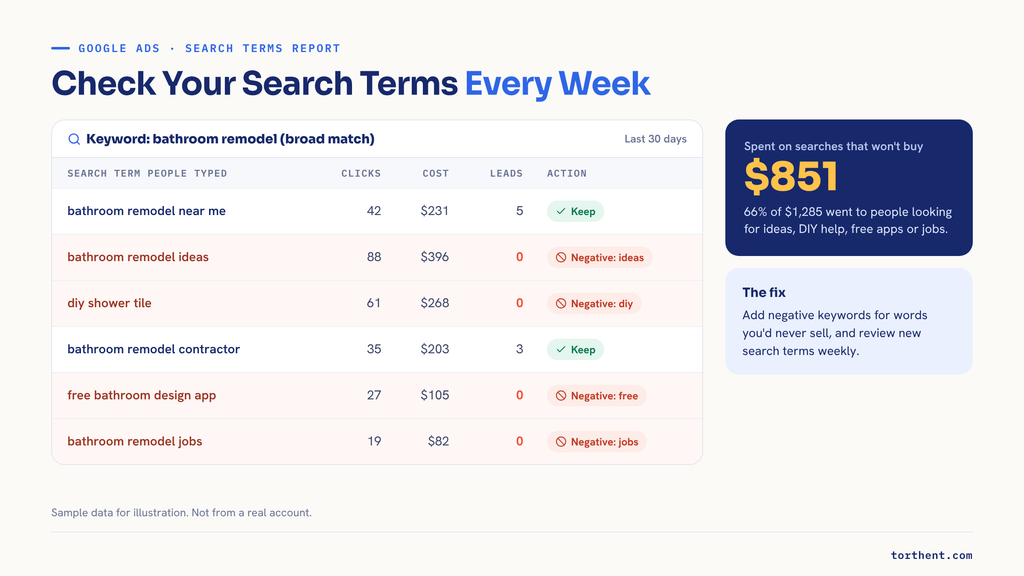
Broad match keywords let Google show your ad for loosely related searches. A bathroom remodeler bidding on “bathroom remodel” can end up paying for “bathroom remodel ideas” or “DIY shower tile,” bringing browsers instead of buyers. Open the search terms report every week and add negative keywords for anything you’d never sell. Google’s newer AI-driven matching, including Google Ads AI Max, widens reach even further, so those reviews matter more now.
A service area set wider than you actually travel does the same damage. On Meta, wide audiences and automatic ad placements rack up cheap clicks from people who tap by accident, so check the placement breakdown and cut the ones that bring no leads.
Your Offer Isn’t Attractive Enough
A good ad earns the click. The offer earns the lead. “Contact us for more information” gives a visitor no reason to act today, so they look around and leave. And when your ad says the same thing as the three competitors above it, price is the only thing left to compare.
Feed scrollers weren’t looking for you, which explains a lot of “Facebook Ads no sales” complaints. Stronger offers are specific and low-risk: a free estimate, a same-week appointment, a clear guarantee or a useful guide.
Your Landing Page Doesn’t Match Your Ad
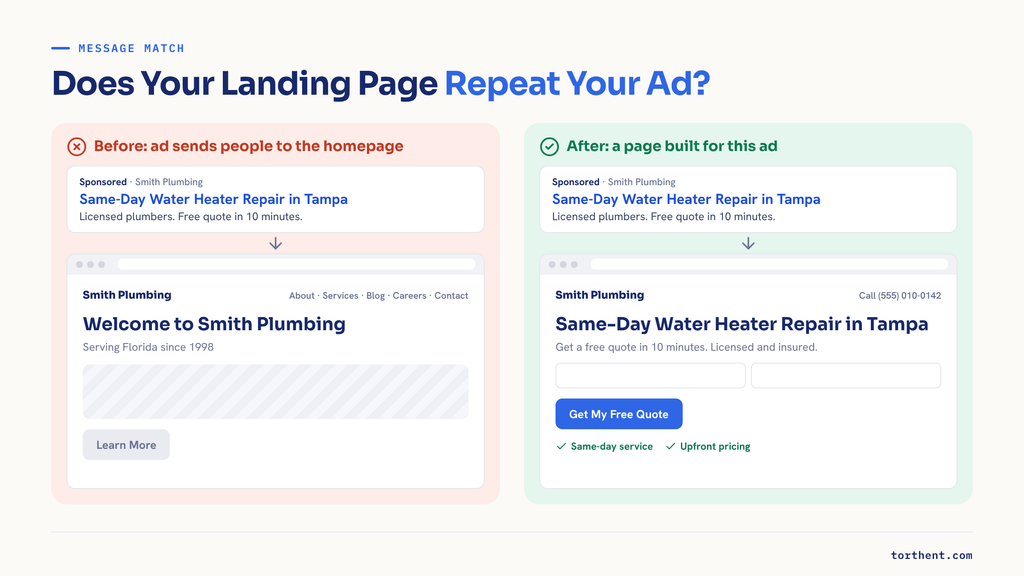
Message match means the page repeats the promise, offer, and wording of the ad the person just clicked. If the ad says “Same-Day Water Heater Repair in Tampa” and the page opens with “Welcome to Smith Plumbing, Serving Florida Since 1998,” the visitor has to hunt for what they came for. Most won’t.
Sending paid traffic to the homepage is the most common of all landing page mistakes. Google scores this too. Quality Score is built from expected click-through rate (CTR), ad relevance, and landing page experience, which Google describes as “how relevant and useful your landing page is to people who click your ad.” Give each campaign their own page, and if the words on it aren’t doing the job, landing page copywriting built around that one offer is often the quickest fix.
Your Website Is Difficult to Use
Most ad clicks happen on phones, so test there first. Open the landing page on cellular data, not office Wi-Fi, and try to become a customer.
Watch for a page that takes several seconds to load, text or buttons that run off the screen, a pop-up covering the form, and a click-to-call button that does nothing. Forms deserve extra attention. Long forms with too many fields lose people halfway, and some forms look fine but never submit or never reach anyone’s inbox. When the site itself is the problem, solid website development will do more than any change to the ads.
Your Call to Action Isn’t Clear
One page should ask for one main action. A page that offers a phone number, a chat box, a newsletter signup, a brochure download, and a quote form all at once leaves visitors to choose, and many choose nothing.
Button wording matters more than it looks. “Submit” and “Learn more” say nothing about what happens next. Tie the button to the offer instead, with wording like “Get My Free Quote” or “Book a 15-Minute Call.” Put it where people see it without scrolling. For owners asking how to improve conversion rate without touching the ads, this is one of the cheapest places to start.
Your Pricing or Message Creates Confusion
Confused visitors don’t buy, and plain writing pays off. Unbounce studied more than 41,000 landing pages and 57 million conversions and found a median landing page conversion rate of 6.6%. Pages written at a 5th to 7th grade reading level converted at 11.1%, 56% higher than pages written at an 8th to 9th grade level (Unbounce Conversion Benchmark Report).
Pricing brings a separate kind of drop-off. Surprise fees at checkout send eCommerce shoppers away, and many service buyers won’t call until they have a rough idea of cost. A simple range, such as “most kitchen remodels run $25,000 to $45,000,” screens out poor fits.
You’re Measuring the Wrong Results
Owners who search “Google Ads no conversions” while their phone keeps ringing usually have a tracking problem. Typical culprits include a Google tag that was never installed or broke during a site update, page views or button clicks counted as conversions, and no connection between the ad platforms and the CRM, so nobody knows which leads became customers. On Meta, running the Meta Pixel without the Conversions API lets browsers and privacy settings block part of the data, which can make Meta Ads not converting look worse than reality.
Both platforms learn from whatever you tell them a conversion is. Count the wrong action, and the system goes out and finds more people who take that wrong action. Offline conversion import, which sends closed sales from your CRM back to Google, teaches the system what a real customer looks like.
How to Find Out Where You’re Losing Customers
Check the path in the order a customer travels it:
- Ad reports. Review search terms, placements, and audiences. Compare click-through rate against conversion rate by campaign to spot campaigns that attract clicks but not leads.
- Website behavior. Use the landing page reports in Google Analytics. Compare mobile against desktop, and look at time on page and scroll depth.
- Forms and calls. Submit every form yourself, call the tracked number and confirm each lead arrives where it should.
- Sales inquiries. Measure how fast leads get a reply, how many are qualified and what reasons people give for not buying.
Match what you see in the reports to the likely cause:
| What you see | Likely cause | Where to check |
| High CTR, low conversion rate | Landing page or offer problem | Landing page report, page on a phone |
| Low CTR | Ad copy or targeting doesn’t fit | Ad and audience reports |
| Many clicks from unrelated searches | Targeting too broad | Search terms report, placements |
| Plenty of leads, few sales | Lead quality or slow follow-up | CRM notes, call recordings, reply times |
| Conversions in the platform, nothing in the CRM | Broken or misconfigured tracking | Conversion settings, tag or Pixel setup |
| Visitors leave the form halfway | Too many fields or a broken form | Form test, form analytics |
Step four is the one most ad reports skip. A lead who waits two days for a callback has often hired someone else by then. Looking at the full sales funnel, from first click to signed deal, shows whether the ads, the page or the follow-up is costing you the sale.
Should You Increase Your Ad Budget?
Not until you know where the leaks are. More budget sends more people into the same leaks, and your cost per acquisition (CPA), what you pay to win one customer, stays flat or climbs.
Here’s an example with made-up round numbers. It is not client data.
| Today | Double the budget | Fix the landing page | |
| Monthly ad spend | $3,000 | $6,000 | $3,000 |
| Clicks ($5 each) | 600 | 1,200 | 600 |
| Conversion rate | 4% | 4% | 8% |
| Leads | 24 | 48 | 48 |
| Customers (25% close rate) | 6 | 12 | 12 |
| Cost per customer | $500 | $500 | $250 |
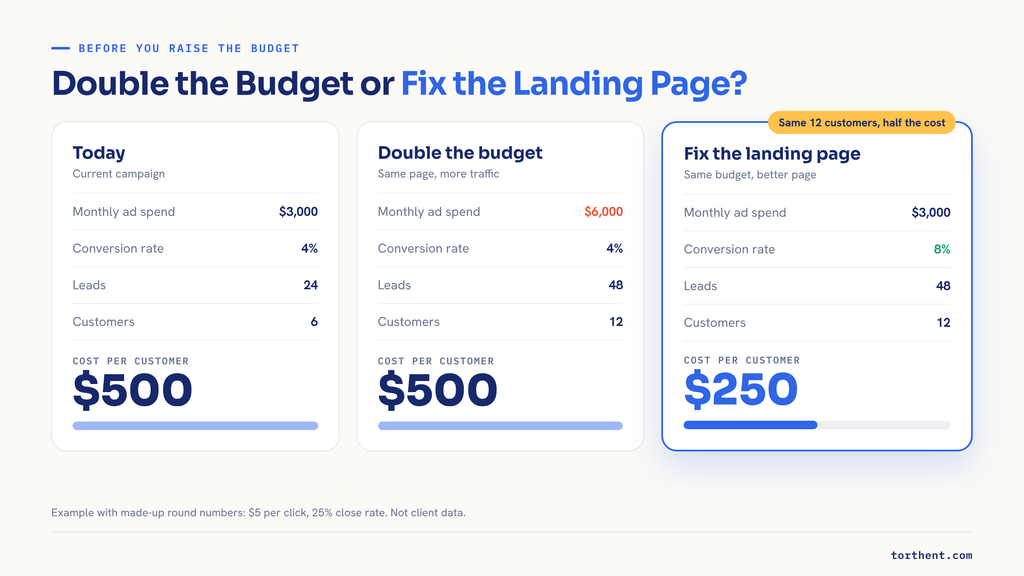
Fixing the conversion rate brought in the same 12 customers as doubling the budget, at half the cost per customer.
That’s also the honest answer to “is Google Ads worth it?” and “are Facebook Ads worth it?” Both can be, once the page and follow-up are ready for the traffic. We cover the marketing assets to build before spending more on ads in a separate guide. Raising the budget makes sense when three things are true: tracking works, the cost per customer is profitable, and budget, not demand, is holding the campaign back.
What a Good Advertising Campaign Should Deliver
Judge a campaign by what reaches the bank account, not the ad dashboard. A healthy campaign produces:
- Qualified leads your sales team wants to call back
- Sales you can trace back to specific campaigns
- A customer acquisition cost (CAC) that leaves room for profit when compared against what a customer is worth
- Return on ad spend (ROAS) for eCommerce, measured on profit rather than revenue alone
- Steady growth you can scale with confidence
CAC is simple math: total ad and sales cost ÷ new customers. Whether the result is good depends on what a customer brings in over time.
For reference, LocaliQ’s 2026 search advertising benchmarks put the all-industry averages at a 6.64% click-through rate, $5.42 cost per click, 8.18% Google Ads conversion rate, and $66.69 cost per lead. Cost per lead also fell overall for the first time in five years. Treat these as rough reference points. Results vary by industry, offer, and market, and these figures cover search ads, so your Facebook Ads conversion rate needs a separate baseline.
In our lead generation case study, Summit Financial Group ran campaigns that drove traffic but didn’t convert. We rebuilt the landing pages around user intent, simplified the message, strengthened the calls to action, added trust content, refined targeting, and set up conversion tracking. Cost per lead dropped 36%.
How TORTH Marketing Turns Clicks Into Customers
We start where the money leaks by reviewing your ad accounts and tracking across Google, Meta, and TikTok. From there, we build offers and ad copy around what your buyers care about, and we write and build a matching landing page for each campaign. Follow-up emails keep leads warm until they’re ready to buy. Our reports track cost per qualified lead and cost per customer, not just clicks.
Get a Second Look at Your Ad Spend
If your ads are getting clicks and your sales numbers aren’t moving, an outside review often finds the leak quickly. We’ll go through your ad account, tracking and landing pages, then show you what to fix first. Request an ad account review and see where your budget is going. We build the growth engine behind ambitious brands.
FAQs
Why am I getting clicks but no conversions?
Most of the time, the ad is reaching the wrong people, the offer gives them no reason to act, or the landing page makes acting hard. Broken tracking can also hide conversions that did happen. Check your search terms or audience reports first, then test the landing page and form on a phone, then confirm your conversion tracking records real leads.
Why are my Facebook ads getting clicks but no sales?
People on Facebook and Instagram weren’t searching for you, so a vague offer or a slow, cluttered page loses them fast. Wide audiences and automatic placements can also bring cheap, accidental clicks. Tighten the audience, review placement reports, send people to a page that matches the ad and set up the Meta Pixel with the Conversions API so Meta learns from real purchases.
Why are my Google Ads getting clicks but no calls?
Start with the basics. Make sure call tracking works, the click-to-call button dials on a phone and someone answers during the hours your ads run. Then review the search terms report for unrelated searches. If people land on a page with no visible phone number or no reason to call now, they leave and call a competitor instead.
Why are my Google Ads not showing conversions?
Usually the conversion action isn’t set up, the Google tag isn’t firing, or the tag sits on the wrong page. Conversions can also take time to show up. Reporting can lag by a few hours, and Google credits each conversion to the date of the ad click, so a sale made days later appears under an earlier date. Test a conversion yourself and check its status.
What is a good conversion rate for Google Ads?
LocaliQ’s 2026 benchmarks put the all-industry average Google Ads conversion rate at 8.18%. Treat that as a rough reference, not a target. Rates vary widely by industry, offer, and market, and a lower rate can still be profitable when each customer is worth a lot. Your own past results and cost per customer are better guides.